
When the Merchant Navy goes to war
The QE2 in the Falklands War, by Commodore Ronald Warwick and David Humphreys
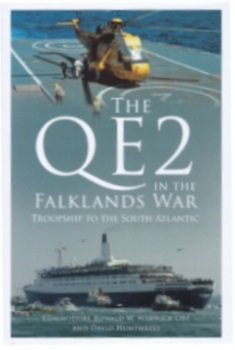 When the Cunard liner Queen Elizabeth 2 became a STUFT (ship taken up from trade) in the 1982 Falklands War, the vessel's civilian crew were up for the challenge. Their mission was to deliver hundreds of squaddies to the South Atlantic, and most volunteered for the voyage, either serving in their usual roles or something similar – like the onboard hairdresser who switched from perms and sets to military cuts.
However, it was not simply a question of inviting the troops onboard and setting off. Major work was needed to reinforce the open decks so large helicopters could land on them, not to mention converting cabins to accommodate more personnel and installing protective coverings so the liner's luxurious fixtures and fittings weren't damaged by military boots.
Much of this work was carried out in just eight days at the vessel's berth in Southampton, but carpenters, engineers and painters in the QE2's crew and army passengers were kept busy throughout the time at sea. Notably, after the vessel had left port with huge fanfare and media interest, it had to anchor quietly on the other side of the Isle of Wight for emergency repairs to the boilers.
This wryly-related story is typical of the crew memories in The QE2 in the Falklands War, which is authored by Nautilus member Ronald Warwick and his former colleague David Humphreys. Commodore Warwick famously went on to be the master of the QE2, but in 1982 he was chief officer on the vessel, and therefore served in the South Atlantic.
Many of the memories in the book come directly from Warwick and Humphreys themselves, but they have also done an excellent job of collecting information from fellow veterans and other historical sources. We hear from all kinds of ranks and roles, and there are some nice period details, such as the pub in Southampton docks offering the crew and soldiers a 20p discount on pints before they left.
Of course, war is a serious business, and the QE2 had an important job to do, taking troops to Ascencion Island and South Georgia and bringing home the survivors of the sunken warships HMS Ardent, HMS Antelope and HMS Coventry. The vessel's doctors and nurses cared for injured servicemen on that homeward voyage, with such good effect that only one patient needed further hospital care back in Britain. Fine work by the crew, and a well-written history that does them justice.
The QE2 in the Falklands War: Troopship to the South Atlantic
By Commodore Ronald Warwick and David Humphreys
History Press, £25
ISBN: 978 18039 97384
Buy this book in the Nautilus Bookshop
While you're there, why not browse the rest of the titles in our unique maritime bookshop, which sells all the books reviewed on these pages.
Buy nowMore Books
Back in time to a lost era of craftsmanship
The Vanishing Age of Sail: The Illustrated Journals of Kelsick Wood, Shipbuilder by Simon Francis BrownThe Vanishing Age of Sail offers a richly textured glimpse into 19th-century maritime life through the illustrated journals of shipbuilder Kelsick Wood.
Mersey memories
Mersey Shipping Since 2000, by Ian CollardFor those retired seafarers lucky enough to live at Nautilus Mariners’ Park, every day is a shipspotting day on the River Mersey. But for the rest of us, there’s the picture book Mersey Shipping Since 2000
Women who went from unsung to unstoppable
Seafaring Women Through History by Jo StanleyMaritime historian Dr Jo Stanley is back with a celebration of trailblazing female mariners – blending rich historical insight with contemporary perspectives to reflect on what it means to be a woman working at sea.
Titanic connections: the other ships on the scene
The Titanic Fleet: the ships involved in the Titanic disaster By Richard M. JonesRichard Jones has explored another aspect of the sinking – the stories of 30 other vessels that were connected in some way to the famous liner.