
- Topics
- Campaigning
- Careers
- Colleges
- Community
- Education and training
- Environment
- Equality
- Federation
- General secretary message
- Government
- Health and safety
- History
- Industrial
- International
- Law
- Members at work
- Nautilus news
- Nautilus partnerships
- Netherlands
- Open days
- Opinion
- Organising
- Podcasts from Nautilus
- Sponsored content
- Switzerland
- Technology
- Ukraine
- United Kingdom
- Welfare
From sea cadet to chief mate: Nautilus catches up with third officer member Gareth Hampton
17 March 2026
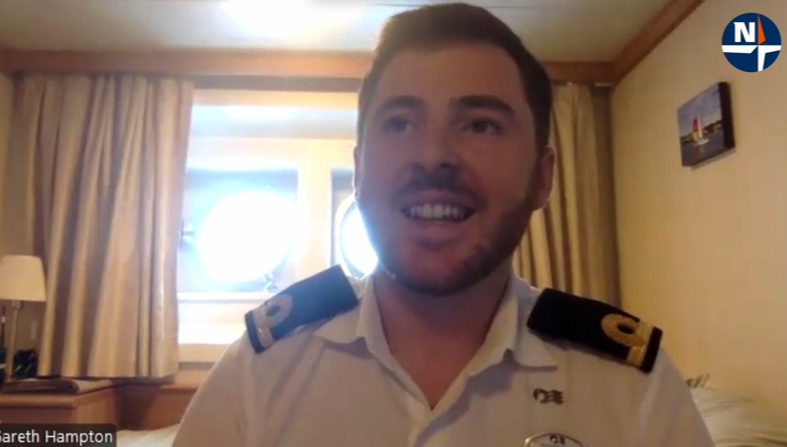
Nautilus International reconnects with member Gareth Hampton – now a qualified chief mate – after first meeting him back in 2020 as a cadet. Gareth talks about his route from Northern Ireland's Sea Cadets to serving as senior bridge watchkeeper on a LNG-powered cruiseship, and the realities of progressing through the ranks.
Congratulations on passing your Chief Mate's Unlimited certification. How would you describe that journey?
I passed my Chief Mate's Unlimited ticket at the end of 2025. For anyone unfamiliar, the chief mate is essentially the captain's second in command, running the deck department – personnel, navigation oversight, life-saving appliances (LSA) and fixed firefighting equipment (FFE). It's a major step up in responsibility.
Your interest in maritime life began early through the Sea Cadets?
Yes – I joined Dundonald Sea Cadets in Northern Ireland when I was 14. Coming from a landlocked area, it opened a whole new world: sailing, kayaking, rowing, and the teamwork and leadership skills I didn't realise would become so important later. That experience pushed me to pursue a professional career at sea.
I later did my cadetship with Princess Cruises, and now I volunteer with the Sea Cadets in Portrush, where I live, and I am a trustee of the MSSC (Marine Society & Sea Cadets), contributing to governance and procedures. Funny thing is, I had no family history at sea – but now my sister also works in maritime but in a slightly different sector with Sail GP. We've become a nautical family completely by accident!
Is there a strong link between your STEM career and Sea Cadet training.
A: Absolutely. the Sea Cadets gave me a great grounding in navigation and meteorology. STEM fits perfectly with maritime training – young people gain real technical skills and soft skills at the same time. I can't recommend it enough.
Is the chief mate ticket the same as a master's licence?
Not quite. The chief mate is a senior on call officer and you can convert it [upgrade] to a master, but it's not the full master's licence. That's the next step.
What was training for the chief mate like?
Intense. It takes late nights and a good support group. You sit both navigation and stability exams, and then the MCA oral exam, which draws heavily on real experience at sea.
I prepared for about six months, full time. I left my vessel in January 2025 and didn't rejoin until December. I completed the course at Warsash Maritime School. Princess Cruises supported me with study leave and an allowance, which helped massively.
The written exams are taken in person; the MCA oral was online – mine was in September 2025.
How did the earlier Officer of the Watch (OOW) and other certificates feed into this?
OOW gave me the foundation. I completed it in 2022, then clocked around 18 months' sea time before applying for chief mate training. The jump to chief mate is all about management-level thinking – you're preparing for scenarios where you might be the senior officer on call.
Has your career progression been fast?
I'd say it's normal. My background with the Sea Cadets gave me a head start with maritime terminology and working in a nautical environment, but overall it's been steady and on track.
What have you enjoyed most about life at sea?
The travel – Alaska, glaciers, wildlife. But more than that, the people. You meet cultures and beliefs you'd never encounter at home. It can be lonely at times, so building meaningful friendships is essential. Some of my closest friends now live thousands of miles away, all from ships.
What is time at sea in the cruise sector like?
It's very rank-based. I currently do three to four months on, and two months off. As you progress, it usually becomes three on, three off.
The industry is changing with decarbonisation and new fuels. How are you preparing?
It's an exciting time. I was part of the inaugural team for Sun Princess, Princess Cruises' first LNG-powered ship. To work on her, I completed the LNG basic certification in Glasgow – funded by the company – and spent time in the yard during the build to become familiar with its operating systems and procedures. Being part of a ship's construction was an incredible privilege and was very beneficial for me.
How long have you been a Nautilus member?
Since 2018, as a cadet. Nautilus helped secure my study leave for chief mate and supported me through the MCA requirements. I'd recommend membership to anyone.
Finally, what's next for you?
I'm back on board after nearly a year away, so I'm finding my rhythm again. I'm hoping for promotion when the opportunity arises. I'll be working toward my master's licence and sea time.
I'm also really interested in the policy and decarbonisation side of the industry. During the pandemic, I worked on simulator-based training proposals for cadets at Warsash when sea time was limited. The regulatory side fascinates me – something I may pursue later in my career.

Join Nautilus International!
Be part of the union for maritime professionals
Wherever you are, so are we
We are the voice of maritime professionals, at sea and ashore. We have a say on all the major issues affecting our members.
✓Certificate protection
✓Legal assistance
✓Dispute resolution
Tags