
How industrialised port cities shaped our society
Unlocking the World, by John Darwin
Veteran scholar of empire John Darwin, who served until his recent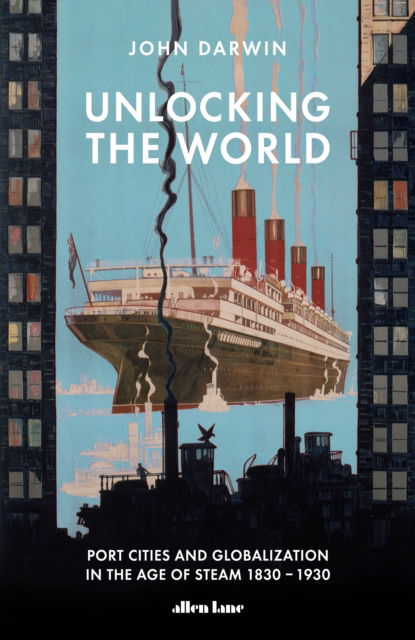 retirement as Professor of Imperial and Global History at Oxford University, turns his attention to the ‘Steam Century’ in this new volume.
The focus of Unlocking the World is on port cities and their role in a rapidly globalising world, as new technology – the steam ships and railways of the Victorian era – allowed reliable trans-oceanic trade for the first time. Why port cities? As Darwin points out, while Western Europe was soon criss-crossed with railways, in Asia, Africa, South America and even Russia it was only the coastal entrepots that were truly connected to the world by these new machines.
Much of the book is given over to case histories of the coastal boomtowns, from New Orleans and Montreal to Smyrna, and from Bombay and Calcutta to Shanghai. The chosen cities illustrate the global reach of the age of steam, as places that were previously inaccessible to Europeans and Americans were rapidly drawn into a system of imperial capital based in the old world.
In great detail, but in an engaging and readable style, Darwin explains how these cities were created, nations transformed and local societies moulded by new machines and outside influences. The text is supported with a series of helpful maps and finely detailed black-and-white illustrations.
It’s worth emphasising that, unlike most of the books reviewed in Telegraph, seafarers are not the focus here. Nor, indeed, are the ships themselves. Though mariners and their machines played a key role in building the new world that emerged from the 19th century, Darwin’s interest is in what was enabled through their work – a transformation of global politics, economics, urban development and society.
There are few personal anecdotes but plenty of percentages, facts and figures; the book focuses on sweeping trends rather than the lives of individuals. Some readers may find this rather dry, but history fanatics will be captivated, and seafarers who have visited some of these cities may be interested in how they took shape.
In his conclusion, Darwin points out how different our modern world is from the age of steam – today the busiest trade routes are across the Pacific, the greatest ports are in Asia, new empires are emerging, migrants flow north instead of south, and environmentalism and digital technology are powerful forces. Yet the contours of our own world emerged during the period of steam globalisation. Darwin’s book is a recommended read for anyone wondering how exactly the modern world came to be.
Buy this book in the Nautilus Bookshop
While you're there, why not browse the rest of the titles in our unique maritime bookshop, which sells all the books reviewed on these pages.
Buy nowMore Books
Back in time to a lost era of craftsmanship
The Vanishing Age of Sail: The Illustrated Journals of Kelsick Wood, Shipbuilder by Simon Francis BrownThe Vanishing Age of Sail offers a richly textured glimpse into 19th-century maritime life through the illustrated journals of shipbuilder Kelsick Wood.
Mersey memories
Mersey Shipping Since 2000, by Ian CollardFor those retired seafarers lucky enough to live at Nautilus Mariners’ Park, every day is a shipspotting day on the River Mersey. But for the rest of us, there’s the picture book Mersey Shipping Since 2000
Women who went from unsung to unstoppable
Seafaring Women Through History by Jo StanleyMaritime historian Dr Jo Stanley is back with a celebration of trailblazing female mariners – blending rich historical insight with contemporary perspectives to reflect on what it means to be a woman working at sea.
Titanic connections: the other ships on the scene
The Titanic Fleet: the ships involved in the Titanic disaster By Richard M. JonesRichard Jones has explored another aspect of the sinking – the stories of 30 other vessels that were connected in some way to the famous liner.