
- Topics
- Campaigning
- Careers
- Colleges
- Community
- Education and training
- Environment
- Equality
- Federation
- General secretary message
- Government
- Health and safety
- History
- Industrial
- International
- Law
- Members at work
- Nautilus news
- Nautilus partnerships
- Netherlands
- Open days
- Opinion
- Organising
- Podcasts from Nautilus
- Sponsored content
- Switzerland
- Technology
- Ukraine
- United Kingdom
- Welfare
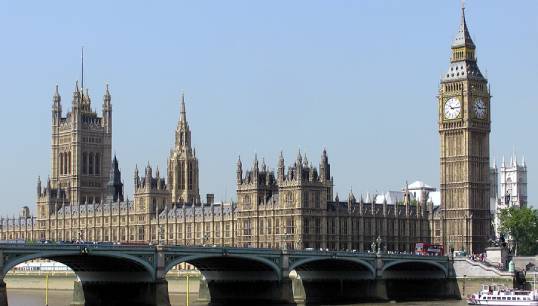
The UK Employment Rights Bill finally received Royal assent on 18 December 2025. Now an Act of Parliament, it represents the most significant overhaul of UK workers' rights in a generation and ushers in some major positive changes for maritime professionals after years of lobbying by Nautilus. Rob Coston looks at the implications
The Employment Rights Bill has now become law after extended parliamentary wrangling. It introduces wide-ranging rights for workers, even after the government scaled back some headline proposals such as day-one unfair dismissal in a political compromise between employers and unions. The reforms are being implemented in phases during 2026 and 2027.
The Act forms a core part of the government's 'Make Work Pay' agenda, aiming to boost living standards by strengthening workplace protections and modernise outdated labour law frameworks
'it's the largest improvement in working rights in a generation, the biggest since the introduction of the Minimum Wage, and represents a shift in the balance of power in UK industrial relations to a more even playing field,' says Nautilus director of organising Martyn Gray.
For Nautilus members, this Act follows on from important legislation introduced post-P&O Ferries, including the Seafarers Wages Act 2023, which requires vessels operating a service regularly using a UK port to pay seafarers the UK National Minimum Wage equivalent for work done in UK territorial waters with the aim of stopping fire and rehire practices and undercutting of pay.
The Seafarers Wages Act, however, has serious weaknesses as loopholes allow for structuring route destinations to avoid falling under the law. It is also no guarantee of protection from fire and rehire, doesn’t cover conditions outside UK territorial waters, and fails to protect broader pay, rostering and working terms. The new Act addresses many of these serious issues and strengthens protections.
How does this affect me?
Seafarers, including Nautilus members, have gained some valuable new protections under the Act, addressing longstanding gaps in how UK labour law applies at sea.
Mr Gray summarises the impact: 'We've got long-term improvements in welfare, safety, job security, pay and overtime from this landmark piece of legislation. Even some of the legal loopholes caused by the flag of convenience system are being closed.
'Nautilus has led advocacy and direct lobbying to government stakeholders, to MPs. Lords and government departments. We've had meetings, briefings, committee evidence sessions. We've directly campaigned to ensure that the Act contains maritime specific protections, whereas in in previous employment legislation there's been a maritime opt-out for employers. And we've pressed ministers to make sure that the act reflects the realities of seafaring work.'
One of the most important developments is the creation of powers to introduce a mandatory seafarers' charter, which builds on the voluntary charter introduced by the previous government in the aftermath of the P&O Ferries dismissals. While the voluntary charter relied on operator buy-in and had limited enforcement, the new Act allows the charter to be placed on a statutory footing, enabling legally enforceable standards on working conditions such as hours of work, rest, fatigue management, training and welfare for services that regularly call at a UK port.
Nautilus International consistently argued that the voluntary measures were not enough and campaigned for binding rules, giving evidence to parliamentary committees and pressing ministers to ensure the charter had real legal force.
The Act also strengthens protections linked to pay by reinforcing the framework that requires operators on regular UK routes to ensure seafarers are paid at least the UK National Minimum Wage equivalent for relevant work. These measures are intended to prevent undercutting and exploitation, particularly by operators using complex employment structures or overseas contracts. Nautilus played a prominent role in highlighting pay abuses in the sector, pushing for tougher enforcement mechanisms.
More broadly, the Employment Rights Act's reforms to unfair dismissal, collective redundancy rules and restrictions on the use of fire and rehire tactics have indirect but important implications for seafarers. Although maritime employment has often sat at the margins of standard UK employment protections, these changes strengthen job security and make it harder for employers to repeat practices such as mass sackings without consultation. Maritime professionals should no longer be excluded from these baseline protections simply because their workplace is at sea.
Finally, Nautilus and other unions have been concerned that maritime professionals can struggle to access representation. The Act now means that qualifying trade unions will have a clearer right to access workplaces for specific purposes such as meeting, representing, recruiting or organising workers and facilitating collective bargaining. Previously, unions could only access workplaces with the employer's consent or by narrow tribunal orders.
Plenty to fight for
While the Act marks a significant step forward for seafarers' rights in UK law, for Nautilus it is not the end of the journey.
The Act is so sweeping that it will take several years, perhaps up to 2028, to take full effect. In the meantime, we will learn more about the details and how the provisions will be enforced through the secondary legislation – which Nautilus will continue to work on.
The Union continues to campaign for robust implementation, strong enforcement, and further reforms to address fatigue, rostering and the limits of UK jurisdiction when vessels operate beyond territorial waters. In addition, many of the provisions of the Act will apply only to vessels that call into a UK port more than 120 times within a year – a number that the Union will be working to lower.
'There are gaps, and where we identify those gaps we will undertake ongoing work after the Act and the secondary legislation comes into force,' Mr Gray says. 'But fundamentally, the work that we have done has delivered for our members.'

How can members join the campaign?
Mr Gray says that members who are interested in getting involved should contact the Union with their experiences,
'We are always happy to hear from members about where they have found weaknesses in legislation, where they have personally experienced challenges. We had great engagement on the Offshore Wind Workers Concession, where we call for evidence from members who are being impacted. We were able to use the evidence they supplied to demonstrate to the government that change was needed – and that change was effectively delivered.
'Members participating, engaging with us, and telling us about the problems that they're facing in the world of work allows Nautilus to seek change that makes their world of work better. That is what Nautilus exists to do.'
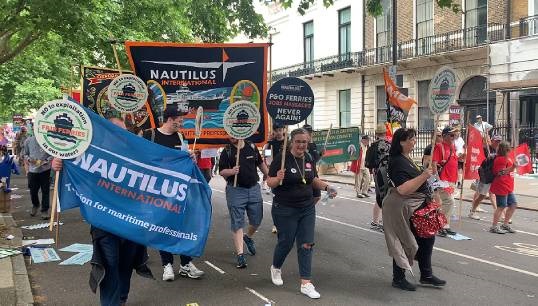
Highlights from the Act
Fire and rehire and harassment
- Dismissing and rehiring on worse terms will become automatically unfair in most cases.
Industrial relations
- Repeal of strike minimum service level rules and enhanced protections for industrial action
- Simplified industrial action notices and ballots
- Electronic and Workplace balloting to become available for statutory union elections
- Improved trade union access and recognition rights
Enforcement
- Creation of the Fair Work Agency: a single enforcement body to oversee compliance with multiple employment rights
Redundancy and consultation
- Expanded collective redundancy consultation obligations and increased protective awards for non-compliance
Workplace rights
- Day-one rights for statutory sick pay, paternity leave, and unpaid parental leave
- Expanded protections against dismissal during pregnancy, maternity leave and return to work
- New and broader bereavement leave rights
- Reduced unfair dismissal qualifying period
- Removal of cap on compensation for unfair dismissal awards
- Extended tribunal time limits
- Enhanced flexible working rights
- Reforms for zero-hours/low-hours workers
- Stronger harassment protections
What do members think about employment rights?
Better contracts
'As a seafarer I work in a globalised industry, and with a globalised industry comes less rights, less governance, less regulation. There is an international framework, which could be described as quite loose, and then nation states sometimes have stronger frameworks.
'I would love to see employment rights for seafarers that are equal to, or better than, employment rights as a general UK worker. Most UK workers have maternity and paternity rights, but for seafarers those rights don't exist. A majority of seafarers are on fixed term contracts, so their employer might just say "Right, your contract has now ended". With that comes a general anxiety, because you could say the wrong thing or act the wrong way at work with the best of intentions and have your employment taken away.
'So I'd love to see better contractual rights, better statutes, better employment rights in the UK, on the UK continental shelf, and encompassing ships that operate in UK waters.'
Covid catalysts
'When covid hit, that was one of the big catalysts to see that that seafarers' rights were quite weak, and therefore ship owners and nation states weren't adopting and weren't practicing these rights as they should have done.'
Enforce our rights
'Over the many years I have spent at sea, employment rights have changed – but we can't forget that there are still employment rights only "by the book" that are not technically enforced.
'I would say that, as a union, we need to properly impose them. That's the best thing we can do. It's a maritime war we are facing but I'm sure, with effort, enthusiasm and dedication, we will get there someday.'
Reduce fatigue
'I'm concerned about making sure rest hours are being maintained, because a big issue is fatigue in the industry, Minimum manning as well. From my experience, that is a huge ongoing issue. I've seen research showing a huge amount of seafarers suffer from fatigue, who don't get enough rest on board, and that leads to mistakes and safety being compromised.
'There's always going to be some discrepancy between workers at sea and on shore, because the environments are so different, but they should be minimalised where they can. One of the best ways to fix an issue like seafarer fatigue is going to be bringing as many shore-based rights to seafaring roles as possible.'
Tackle seablindness
'One of the big challenges is that we have ended up being "out of sight, out of mind", so when you look at the historical legislation there really hasn't been support for seafarers. You look at things like what happened with P&O Ferries, firing and rehiring and it's because there aren't those protections. Issues such as maternity rights have just been disregarded.
'I think the Employment Rights Act will be really positive generally for seafarers, making sure they're recognised. Longer term, and I think something the Union is sort of working towards, is making sure there is a sort of Just Transition when there's a lot of technological change which will alter the industry and we've got to make sure that we support people to have fulfilling jobs and careers.'
Address complexities
'Employment rights are a very complex issue. There are no easy answers, and you're never going to provide everybody with the answer that they want to hear, but we have to at least try ensure that if you are a seafarer or working in the maritime industry there is an understanding about the ramifications of particular aspects of employment rights in relation to that particular industry.
'People's employment rights need to be looked at in a more holistic way, but with the nuances of what being at sea requires from you. The problem is that it is not necessarily understood where the dynamics need to come from to effectively address the issues.'
Tags