
- Topics
- Campaigning
- Careers
- Colleges
- Community
- Education and training
- Environment
- Equality
- Federation
- General secretary message
- Government
- Health and safety
- History
- Industrial
- International
- Law
- Members at work
- Nautilus news
- Nautilus partnerships
- Netherlands
- Open days
- Opinion
- Organising
- Podcasts from Nautilus
- Sponsored content
- Switzerland
- Technology
- Ukraine
- United Kingdom
- Welfare
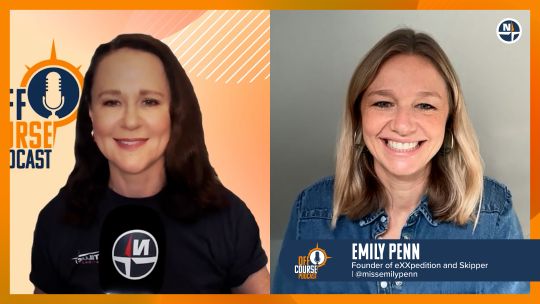
Helen Kelly sat down with Emily Penn, founder of eXXpedition, to find out how a global network of all-women sailing voyages is transforming our understanding of ocean pollution – and why maritime professionals are uniquely placed to help.
The ocean covers more than 70 per cent of our planet, yet less than 20 per cent of plastic pollution in the sea originates there. The rest flows in from land, from rivers, beaches and everyday human activity. That startling figure sits at the heart of eXXpedition's mission, and it is what drives founder Emily Penn to keep sailing.
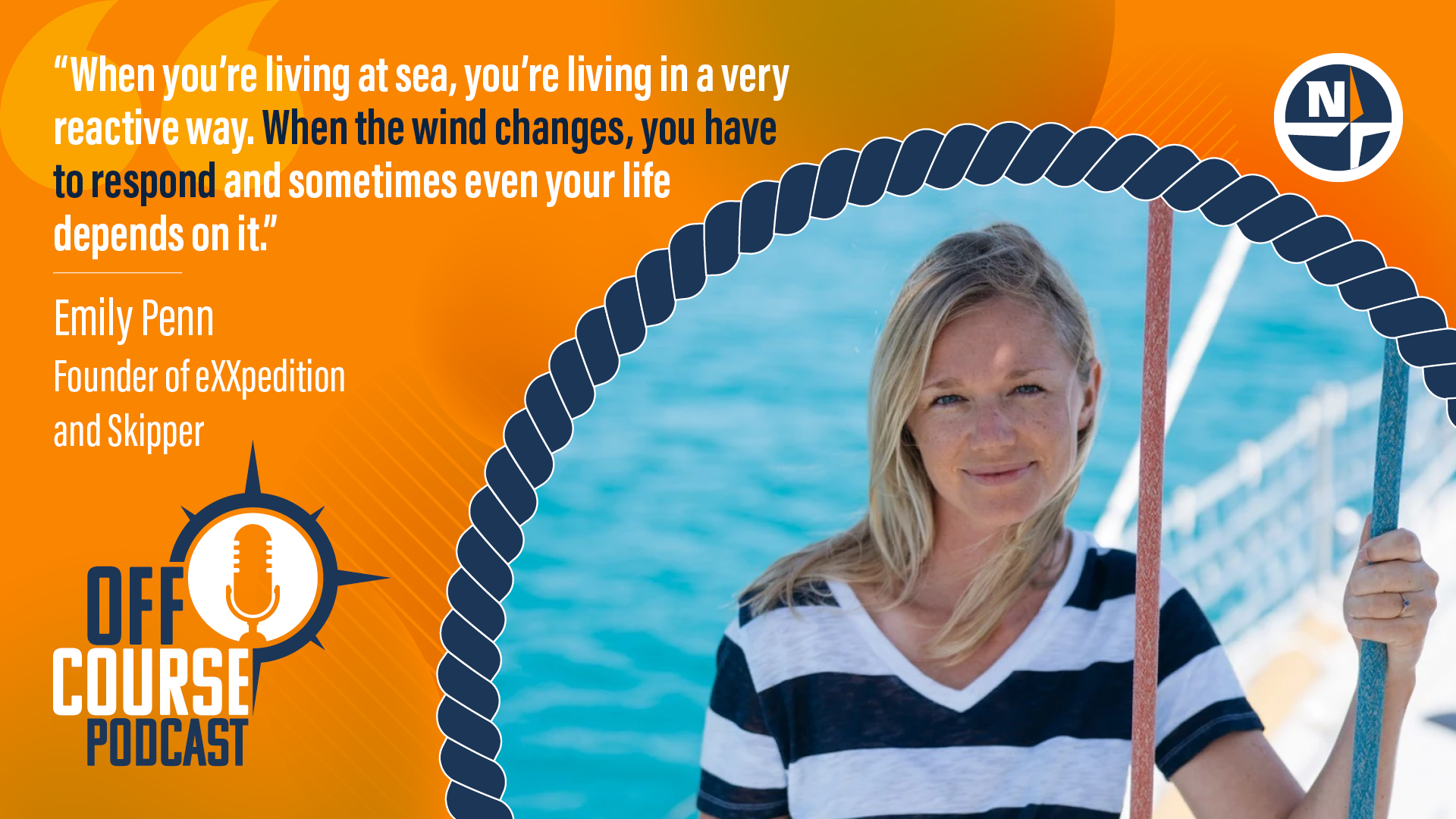
Ms Penn is an ocean advocate, skipper and co-founder of eXXpedition, and has spent more than a decade at the forefront of ocean plastic research. Speaking on our Off Course podcast, she outlined the scale of the challenge, the work her organisation is doing to address it, and the vital role that maritime professionals can play.
The plastic problem
Plastic pollution is one of the defining environmental crises of our time, and the shipping and maritime industries sit squarely in the middle of it– both as contributors and as potential solutions. Ms Penn describes the ocean as 'the world's largest unmonitored environment', a space that receives the runoff of almost every human activity on land.
The most visible sign of that pollution is the infamous 'great Pacific garbage patch' – a vast soup of microplastics in a region where plastic fragments accumulate due to rotating ocean currents called gyres. There are five such gyres across the world's oceans, and eXXpedition has sailed through all of them.
Microplastics – particles smaller than five millimetres – are the most pervasive form of pollution that eXXpedition encounters. These fragments come from the breakdown of larger plastic items, from synthetic fibres shed during washing, and from industrial pellets called nurdles, which form the raw material of almost all plastic products. Nurdles are a particular concern for the shipping industry: spillages during loading and transport at sea can release billions of the tiny pellets into the marine environment.
Ms Penn explains that plastic does not biodegrade in the conventional sense. Instead, it photodegrades – breaking down into ever-smaller fragments under UV light, while the chemical compounds within it remain. Those chemicals, including endocrine disruptors and persistent organic pollutants, are absorbed by marine life and can work their way up the food chain, ultimately reaching humans.
For seafarers, the implications are immediate. Merchant vessels, fishing fleets and cruise ships all generate waste. Management of that waste at sea is governed by MARPOL Annex V but compliance and enforcement remain inconsistent. Ms Penn argues that the culture aboard ships, and the knowledge that individual seafarers bring to their roles, is as important as any regulation. 'The people who spend the most time at sea have the most power to make change,' she says.
Ghost fishing gear – abandoned, lost or discarded nets, lines and traps – represents another significant maritime contribution to ocean plastic. The Environmental Investigation Agency, a UK charity, estimates that around 640,000 tonnes of fishing gear is lost to the ocean every year, though WWF estimates place the upper limit closer to 1 million tonnes. Ghost fishing gear entangles wildlife, continuing to catch fish long after it is abandoned. EXXpedition's research voyages document this gear as part of a broader effort to understand the full spectrum of marine plastic pollution.
One person changes their behaviour. They influence their household, their workplace, their community. That's how systems change.
Science under sail: how the expeditions work
Since its founding in 2014, eXXpedition has completed more than 30 research voyages across the world's major ocean regions. The voyages follow scientific protocols developed in partnership with academic institutions, and the data collected feeds into peer-reviewed research that informs international policy discussions.
On each leg of a voyage, crew members deploy trawl nets designed to collect surface microplastics. Samples are analysed for plastic type, size and chemical composition. The results contribute to a growing global dataset that is helping scientists map the distribution and movement of plastic in the oceans with unprecedented accuracy.
The voyages also test emerging cleanup technologies and assess their practicality at scale. Ms Penn is candid about the limitations: cleanup alone cannot solve the crisis. 'You can't hoover the ocean,' she says. 'The solution has to start on land; with the way we produce and manage plastic in the first place.' But gathering evidence of what is out there, and where, is an essential step in building the case for systemic change.
Three objectives, one mission
eXXpedition's work is structured around three interconnected objectives, each designed to move the needle on ocean plastic pollution from a different angle.
- Cutting-edge ocean research
The primary purpose of every voyage is to collect data. eXXpedition crews carry out standardised sampling protocols that generate comparable results across different ocean regions and time periods. This longitudinal dataset is increasingly valuable to the scientific community and is used to inform everything from product design to international shipping regulations. By placing trained researchers and interested crew members alongside one another at sea, eXXpedition ensures that data collection is both rigorous and continuous.
- Education and capacity building
eXXpedition believes that understanding creates advocates. Every crew member who sails receives training in scientific sampling methods and ocean literacy and returns home equipped to communicate what they have learned. Ms Penn describes a 'ripple effect': one person changes their behaviour, influences their household, their workplace, their community. Over a decade, the organisation has trained more than 300 crew members from over 40 countries, creating a global network of informed ambassadors for ocean health.
- Empowering solutions and systems change
Data and education are tools, but eXXpedition's ultimate goal is action. The organisation works to translate its research findings into practical outcomes – whether that means informing the development of plastic-free packaging, supporting policy advocacy at the IMO, or connecting crew members with industry partners who are developing scalable solutions. Ms Penn is clear that the maritime sector has a pivotal part to play: ships carry 90 per cent of global trade, and the industry's adoption of sustainable practices could transform supply chains worldwide.
The 'eXX' factor
The double-X in eXXpedition is deliberate. All voyages are crewed exclusively by women and non-binary people, a decision that Ms Penn explains serves both a scientific and a social purpose. Research consistently shows that women are disproportionately affected by plastic-related chemical pollution – many of the endocrine-disrupting compounds found in plastics interfere with hormonal systems in ways that have particular implications for reproductive health. By crewing voyages with women and non-binary people, eXXpedition foregrounds those most affected as the agents of investigation and change.
The approach also addresses a persistent gender imbalance in ocean science and in the maritime industry more broadly. Women remain significantly underrepresented at sea, and particularly in senior maritime roles. EXXpedition's voyages provide a high-profile platform that challenges that norm, and Ms Penn hopes the model will inspire younger generations to consider careers in the maritime sector.
Join the 2026 expeditions
eXXpedition is currently recruiting crew for its 2026 programme of research voyages, and Nautilus International members are warmly encouraged to apply. No prior sailing experience is required – what eXXpedition values is curiosity, commitment and a willingness to contribute to meaningful scientific work at sea.
Voyages typically last between two and four weeks and take place across a range of ocean regions, including the Atlantic, Pacific and Arctic. Crew members work alongside professional skippers and scientists, learning sampling techniques and contributing to data collection throughout each leg. Full pre-voyage training is provided.
Ms Penn is particularly keen to welcome maritime professionals into the eXXpedition community. Seafarers bring skills– watchkeeping, navigation, vessel handling, an understanding of the marine environment – that are directly relevant to the work of the voyages. They also carry credibility with the shipping industry, making them effective advocates for change within their own professional networks.
Places on 2026 voyages are available now. Crew members are asked to contribute to the cost of each voyage, and a range of financial support options are available for those who need them. Full details, including information about the application process, available voyages and financial support, are available on the eXXpedition website at exxpedition.com
Tags