
- Topics
- Campaigning
- Careers
- Colleges
- Community
- Education and training
- Environment
- Equality
- Federation
- General secretary message
- Government
- Health and safety
- History
- Industrial
- International
- Law
- Members at work
- Nautilus news
- Nautilus partnerships
- Netherlands
- Open days
- Opinion
- Organising
- Podcasts from Nautilus
- Sponsored content
- Switzerland
- Technology
- Ukraine
- United Kingdom
- Welfare
Nautilus backs new Seafarer Pledge to boost recognition and support across industry
16 June 2026

Nautilus International has pledged its support for a new cross-industry Seafarer Pledge initiative aimed at improving recognition, welfare and long-term support for Merchant Navy professionals throughout their careers. Deborah McPherson reports.
The pledge has been spearheaded by the UK national seafarers' welfare board, the Merchant Navy Welfare Board (MNWB) – where Nautilus holds two trade union trustee positions on the Council of Management. It was introduced to industry stakeholders during a dedicated webinar in June. A wider soft launch is planned for July, giving organisations the opportunity to sign up and begin shaping how the initiative works in practice.
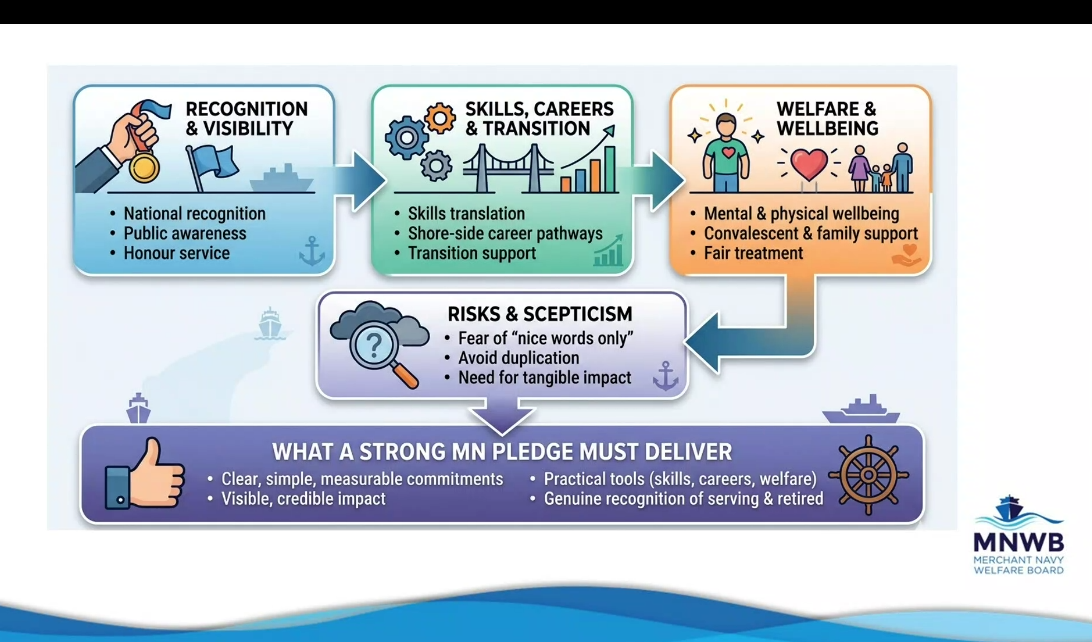
Inspired in part by the Armed Forces Covenant, the Seafarer Pledge will be a lighter touch on this, being designed as a flexible, non-prescriptive framework rather than a regulatory scheme. It will focus on five key 'pillars': improving welfare, strengthening career pathways, supporting transitions from sea to shore, promoting recognition of maritime skills, and increasing public awareness of the value of seafarers.
Sharon Coveney, deputy chief executive of the MNWB, said the initiative is intended to cover the full 'lifecycle' of a seafarer – from cadets through to retirees and their families – reflecting what organisers describe as the whole seafaring community.
'We purposely left it as broad and inclusive as we could. It's about recognising the whole seafarer family, so to speak, and the community.'
Flexible approach to a practical delivery
As a result, rather than imposing fixed requirements, the pledge encourages organisations to take practical steps suited to their size and capability. For some, that could mean offering discounts, developing services, or improving access to welfare support. For others, it may involve recognising seafarers' transferable skills in recruitment or raising awareness internally.
Steven Jones, a maritime consultant on the initiative and founder of the Seafarers Happiness Index, said the pledge could be described as a 'moral compass' for industry, 'creating a shared direction of travel rather than a compliance exercise'.
A toolkit, website and sign-up portal – including certificates and guidance materials – will support this process when the initiative goes live.
Early backing has been strong, with around 16 organisations committed in principle to signing.
Complementing existing protections
The pledge is intended to complement – not replace – existing legal frameworks such as the mandatory UK Seafarers’ Charter – contained in the Employment Rights Act – which focuses on employment standards. Instead, it seeks to address what stakeholders see as a gap around recognition, dignity and public visibility, tackling long-standing 'sea blindness'.
Explaining the Union's support, Nautilus International head of professional and technical David Appleton said: 'We believe that the pledge initiative will play a vital role in elevating awareness of seafarers' issues among the wider public, while actively driving meaningful conversations on how services can be enhanced to better support those at sea.'
Tags