
- Topics
- Campaigning
- Careers
- Colleges
- Community
- Education and training
- Environment
- Equality
- Federation
- General secretary message
- Government
- Health and safety
- History
- Industrial
- International
- Law
- Members at work
- Nautilus news
- Nautilus partnerships
- Netherlands
- Open days
- Opinion
- Organising
- Podcasts from Nautilus
- Sponsored content
- Switzerland
- Technology
- Ukraine
- United Kingdom
- Welfare
Just hire more crew: second officer Cassie Mead on sustainability, mental health, and demanding better for seafarers
17 March 2026
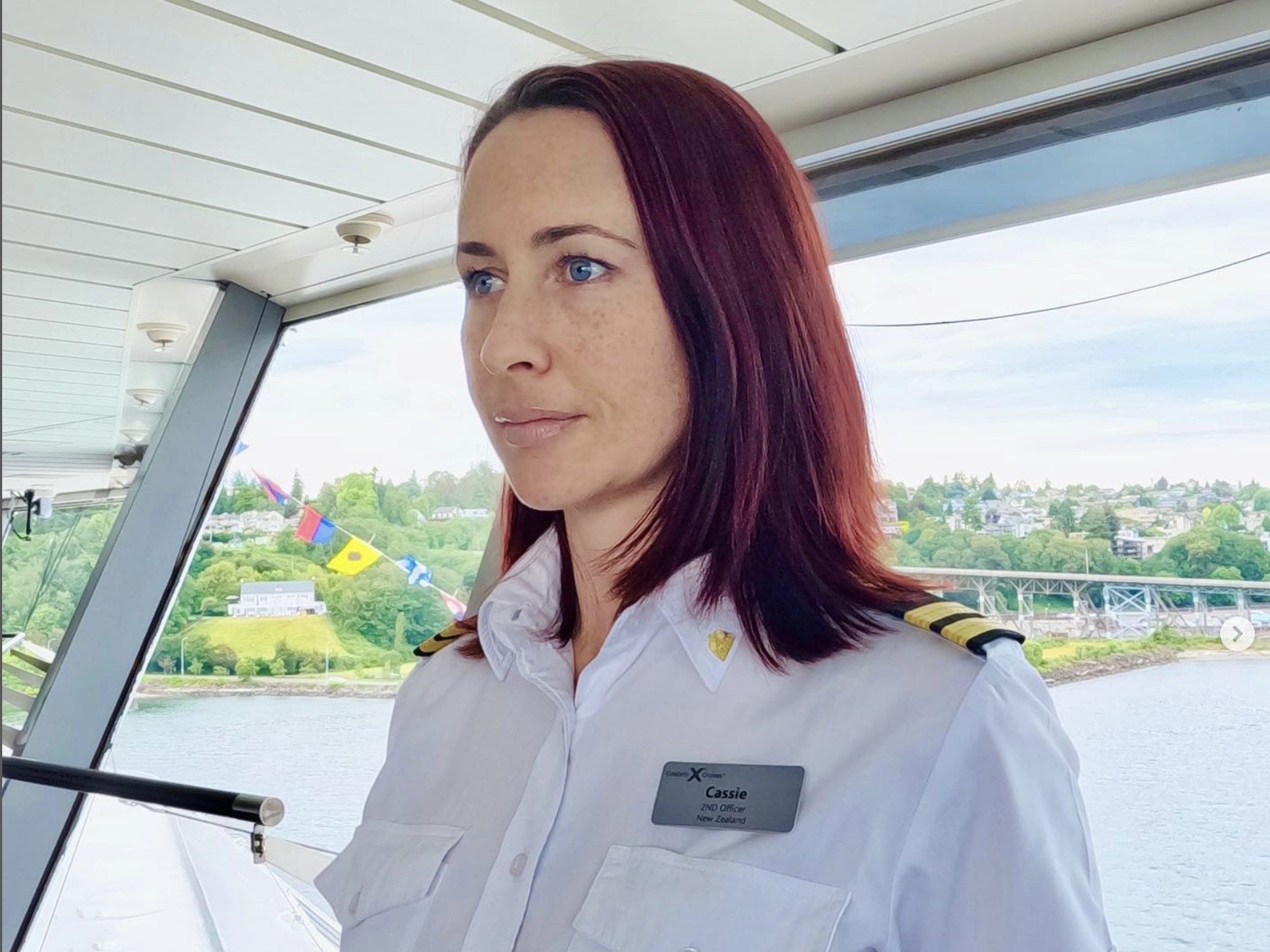
Second officer Cassie Mead has spent over 20 years in the maritime industry, working her way up through the ranks across multiple vessels and employers. In this candid conversation from our Off Course podcast, she tells Helen Kelly why proper crewing levels are key to sustainability, her journey with an ADHD diagnosis, and how Gen Z seafarers are forcing the industry to change
When asked about sustainability in shipping, second officer Cassie Mead cuts straight to the heart of the matter: crew numbers.
'More crew. Just don't understaff us,' she says firmly. 'It's a tough job and it's all good to say "if you can't hack it, get out”. But sustained fatigue leads to things like heart disease, liver disease, early onset dementia. These are not talked about.’
Ms Mead's career has taken her from Swire Shipping to Celebrity Cruises and Holcim, giving her a comprehensive view of how different sectors approach crewing. What she’s observed is troubling: most companies stick to minimum manning requirements rather than investing in adequate crewing.
‘I do find that it’s more common that people stick to the minimum manning because at the end of the day, it’s bottom dollar, unfortunately,’ she says. ‘Just by having a few more crew, you literally make everybody’s lives a little bit easier.
‘Just two more crew members could transform working conditions onboard, allowing for proper rest periods, safer operations, and sustainable work patterns. Yet the industry continues to prioritise short-term cost savings over long-term crew welfare and safety.’
Beyond carbon: what sustainability really means at sea
Whilst acknowledging the importance of environmental regulations and technologies like scrubbers and cleaner fuels, Ms Mead argues that sustainability conversations often miss a crucial element: the sustainability of the workforce itself.
She draws a direct line between adequate crewing and operational safety. The current system, she argues, creates an impossible situation. Maritime Labour Convention (MLC) regulations are treated as guidelines rather than rules, with crew regularly exceeding safe working hours to demonstrate commitment or learn additional skills.
‘The MLC has been more of a guideline than a rule for many,’ she says. ‘The number of breaches that come into it purely just because you’re trying to be seen as a good employee or trying to go out of your way to learn something different. You’ve got to go outside your regular hours and use some of your free time to be learning an extra skill.’
Just two more crew members could transform working conditions onboard, allowing for proper rest periods, safer operations, and sustainable work patterns
Are you a Nautilus member with a story to share?
We're always looking for diverse voices and experiences for future podcast episodes. Email telegraph@nautilusint.org to get involved.
Gen Z are demanding change
Ms Mead sees hope in the next generation of seafarers, who are refusing to accept the unsustainable working conditions that previous generations endured.
‘This Gen Z is going: “Hell no. I don’t want four-month contracts. I don’t want time on, half off. I want two on, two off.” They want time and time," she explains. ‘There’s a lot more boundaries with them and a lot more self-respect and preservation around their rest time and their quality of life.’
The maritime industry’s notorious culture – where crew are expected to work excessive hours, skip breaks, and demonstrate constant enthusiasm – is being challenged.
‘We didn’t read our contracts. We didn’t put our foot down about contracted hours,' Ms Mead reflects on her own generation’s approach. ‘From cadets, we did what we were told, we went everywhere, we overworked, we put in the effort.’
But Gen Z aren’t willing to make those same sacrifices. Ms Mead believes they’ll either leave the industry or force it to change: ‘I think you’ll find that they probably don’t stick around in the industry for very long or they will force the industry to change and catch up with them.’
She’s hopeful it will be the latter: ‘They’re the generation to really bring in the enforcement about neurodivergence and mental health. They’re not embarrassed about mental health like the rest of us have been. They’re going to bring about change from a management level.’
ADHD at sea
Ms Mead was diagnosed with ADHD two years ago, at a point when she was already deep into her seagoing career. The diagnosis came during a period of severe burnout.
‘It was challenging. I always felt like I had two parts of my brain or two sides to my personality,’ she explains. ‘I would recognise repetitive traits that I couldn’t seem to get control of no matter how hard I tried.’
The diagnosis brought clarity but also pain: ‘It’s grieving over a life that could have been. How much different and how much easier could my life have been and how much easier could my time at maritime school have been if I had been medicated and educated on my condition?’
The maritime environment presented challenges for someone with ADHD. Sleep deprivation is already a symptom of the condition, and the addition of four-on, eight-off watch patterns created an unsustainable situation.
‘Sleep deprivation is one of the symptoms of ADHD and then you put midnight to four watches and things on top of that. I’ve spent years not sleeping essentially, so go figure… you get burnout and you can’t emotionally regulate properly when you’re so fatigued,’ Ms Mead says.
The stigma of disclosure
Despite eventually going public about her diagnosis, Ms Mead never disclosed it to her employer at the time. The reason was simple: fear.
‘There were some other challenges I had with them, and it was already apparent to me that despite having women in management roles that were ex-seafarers, they were quite old school themselves and their mentality,’ she explains. ‘I didn’t feel like bringing it up with them was going to lead to me having support. I felt like it was going to be my detriment, that it would be ammunition to use against me.’
She witnessed this attitude firsthand when working with a cadet who also had ADHD. The captain remarked that the cadet was ‘getting into a habit of using it as an excuse’.
‘That’s so hard because it probably does come across as an excuse rather than an explanation,’ Cassie says. "We’re trying to explain why we just said that or why we just did that and we’re apologising for our condition, which is insane.’
She praises organisations like Neurodiverse at Sea in the UK for fighting for funding and policies: ‘I hope it reaches the wider maritime community.’
The road to recovery
After experiencing severe burnout and imposter syndrome, Cassie took most of 2025 off from sea, spending time on a major home renovation project that drew on her degree in architecture. She also worked with a therapist and life coach to better understand herself and develop new coping strategies.
‘ADHD burnout is even worse than regular burnout,’ she explains. ‘I got to a point where I just had to stop.’
The break allowed her to reassess her relationship with the industry. For someone who had always identified as a ‘lifer’, questioning whether to continue was profound.
‘I never thought I'd ever reach that point. I had wanted to go to sea since I was 17 and that was it,’ she says. But burnout forced a reckoning: ‘There were more and more things I was starting to dislike about the industry and how little had changed in the time I'd been at sea.’
A breakthrough came unexpectedly: ‘I had just this epiphany moment one day when I was on my way up the driveway and I went, “I'm a mariner”. That's what I do. That's me. I’m a mariner.’
She returned to Holcim Cement for three short contracts, working on her favourite vessel with her favourite crew. The experience was carefully managed to support her recovery, with the ship laid up for much of the time and crew working day shifts with normal sleep patterns.
The process has brought her to a healthier place: ‘I'm at a place now where I would be happy to go back to sea, but I would also be happy to move on to something else. I feel like that’s a good place to be, that it means I've reached a point where my whole being isn’t tied up in maritime anymore.’
Amplifying women's voices
Alongside her seagoing career, Cassie hosts the Women at the Helm podcast, which she launched during mandatory quarantine when returning to cruising post-COVID.
’I believe women can do anything and I have done my whole life and really wanted to emphasise what we do at sea,’ she explains.
The podcast has a clear mission: to show the reality of women's experiences in maritime, not just the Instagram-worthy moments.
‘I wanted it to be about the nitty gritty. I wanted it to be about the side of the industry that you don’t hear about. The premise of it is share your truth,’ Cassie says.
Rather than discouraging women from entering the industry, the podcast aims to prepare them: ‘Not to scare anybody off, but more so to arm the next generation, to help provide some information, to let them know that they’re not alone out there.’
With women comprising only around 2% of the global maritime workforce, retention is as important as recruitment. Cassie has observed that women tend to leave the industry sooner than men.
‘That 2% is not increasing because the women are coming in, but they’re also leaving as well,’ she notes. ‘Whether it’s because they want to be mothers or because they’re over the long stints at sea or the sleepless years of sleepless nights, or whether they just feel they’ve done their time and they progress shore side.’
Support systems remain inadequate in many companies. Whilst some organisations like the Masters, Mates and Pilots Union in America provide progressive policies including paid shipping of breast milk home, these remain the exception rather than the rule.
‘Women’s issues have been swept under the rug for so long,’ Cassie argues. ‘It’s been a “if you can’t hack it, get out”.’
Design for the future
When asked about changes needed for a sustainable maritime future, Cassie returns to long-term thinking.
‘We need to be looking further into the future, not for the near future. Lithium batteries, for example, are a short-term, near future solution. Somebody came up with this idea, it sounded wonderful, and then nobody’s thought about the repercussions.’
She advocates for more education about environmental impacts amongst seafarers: ‘There needs to be more education around the environmental effects we have on the ocean and marine life and how changes to shipping and vessels can positively impact that in future.’