
- Topics
- Campaigning
- Careers
- Colleges
- Community
- Education and training
- Environment
- Equality
- Federation
- General secretary message
- Government
- Health and safety
- History
- Industrial
- International
- Law
- Members at work
- Nautilus news
- Nautilus partnerships
- Netherlands
- Open days
- Opinion
- Organising
- Podcasts from Nautilus
- Sponsored content
- Switzerland
- Technology
- Ukraine
- United Kingdom
- Welfare
From construction sites to cargo holds: how one engineer is championing sustainability and supporting the next generation of seafarers
6 January 2026
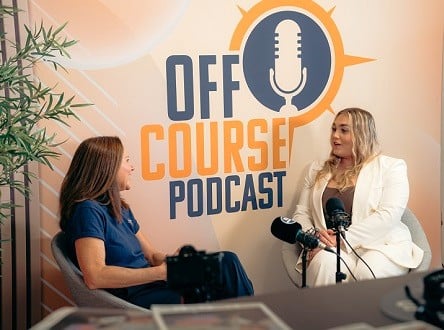
Marine engineer Amilia Busby had an unconventional route into the maritime industry and is now passionate about helping others navigate their own journeys at sea. Helen Kelly hears from a Nautilus award winner who's looking towards a greener maritime future
Not many people can say they discovered their career path through a chance conversation with their boss. But that's exactly what happened to Amilia Busby, a recently-qualified marine engineer currently working on a semi-autonomous trailing suction hopper dredger on the south coast of the United Kingdom.
'I was working on construction sites in London, learning acoustic engineering,' she recalls. 'After Covid, things were slowing down and my boss just said, "Why don't you look at the Merchant Navy?” I turned around and was like, "What's that?"'
That moment of curiosity would transform Ms Busby's career trajectory entirely. Despite growing up near the sea in Hastings, on the south coast of England, and having a grandfather who served as a submariner, the maritime industry had never been on her radar. Like many people, she experienced what the industry calls 'sea blindness' – simply not knowing that working at sea was an option.
'The first thing I saw was "sponsored marine engineering cadetship". I thought, 'I'm already doing engineering, and I don't have to pay for it." That was the biggest incentive for me – I never wanted student debt.'
Are you a Nautilus member with a story to share?
We're always looking for diverse voices and experiences for future podcast episodes. Email telegraph@nautilusint.org to get involved.
Financial benefits
Her interest piqued, Ms Busby took a closer look at maritime officer cadetships, and was immediately attracted by the sponsored training.
'The first thing I saw was "sponsored marine engineering cadetship". I thought, 'I'm already doing engineering in the construction industry, and I don't have to pay for it." That was the biggest incentive for me – I never wanted student debt.'
Despite having no prior mechanical engineering knowledge, Ms Busby's strong grades in maths and science from her school days were enough to secure her place.
Sport vs the sea
Before maritime entered her life, Ms Busby was pursuing a serious rugby career. She attended a specialist rugby college in Worthing, one of only seven women's teams in the UK playing at county level.
'My life was just rugby at that point,' she explains. 'We'd train every other day, and play games on Wednesdays, plus county and club rugby.'
Ms Busby secured a place on the academy programme at the club London Irish, before a devastating ligament injury took her out of the game for several months. The subsequent collapse of London Irish's academy programme forced Ms Busby to reassess her priorities. A career at sea beckoned.
The three-week-on, three-week-off rotation of her current role doesn't allow for the commitment levels required for county rugby, but she's found a balance that works.
'You have to choose one or the other really. When you're at sea doing those long hours and you come home, sometimes you just need to chill out.'
Work aboard a specialist vessel
Today Ms Busby serves on a 120-metre semi-autonomous dredger – a relatively small vessel with a close-knit crew of 12. The ship operates along the Thames estuary and south coast, collecting sand for the construction industry.
'It's a home away from home really,' she says. 'You get food cooked for you, your own cabin with a washroom. We're always on the south coast, so I'm never too far from home in Hastings.'
Working three weeks on and three weeks off gives Ms Busby a unique lifestyle. During her rotation at sea, she handles daily watchkeeping duties as part of a three-person engineering team. During her time ashore, rather than simply switching off, she's become increasingly active in the maritime community.
A beacon for seafarers
Ms Busby is committed to supporting others in the industry, particularly those facing barriers to entry. She's a Careers at Sea Ambassador and the 2025 Nautilus Bevis Minter Award winner.
'I want to be like a beacon to support seafarers,' Ms Busby explains. She is keen to help connect aspiring seafarers with scholarships, placements, and mentorship opportunities.
Qualified seafarers are encouraged to get involved in the industry beyond their vessels. 'I really want to emphasise trying to get seafarers to come out into the industry and show themselves and show what they do. Come to networking events, seminars, conferences. Most of the time I'm one of the only seafarers at these events – maybe there'll be older master mariners, but junior officers and cadets are rare.'
Navigating sustainability
As a marine engineer, Ms Busby is on the frontline of the industry's environmental transition. Her employer, Heidelberg Materials, has made significant commitments to sustainability, recently launching EVO Zero products – the world's first net zero carbon captured concrete and cement range.
'Dredging is looked at as being quite environmentally unfriendly,' she acknowledges. 'So, it's good that we are trying to bring emissions down as much as we can, because concrete is important in construction.'
On her vessel, the crew already uses low sulphur fuel, a change mandated by environmental legislation. But the engineer is acutely aware that bigger changes are coming, and the industry needs to prepare its workforce properly.
The training gap
Although a recent graduate from Warsash Maritime School at Solent University, Ms Busby says alternative fuels received limited coverage in the curriculum, because no standard has yet been agreed by the industry regulator, the International Maritime Organization (IMO).
'We would do a little bit on alternative fuels, but no one really knew enough information about them. They didn't want to give us fake news or fake information, so they didn't talk about it too much.'
She learned about scrubber systems and low sulphur fuels – mainstream technologies – but deeper training on liquefied natural gas (LNG), ammonia, methanol and other emerging fuels wasn't yet available. The curriculum has since been amended, but Ms Busby hasn't yet had the opportunity to work with these alternative fuels.
'I haven't worked on LNG-fuelled ships or ships with scrubber systems. It's a shame because I wish I'd got the chance in my cadetship.'
The question of training for new fuels concerns her. With the IMO's net zero framework discussions ongoing, Ms Busby hopes legislation will eventually require comprehensive training before seafarers work with unfamiliar fuels.
'You can't have people running a ship if they don't understand the fuel. I wouldn't feel comfortable using a fuel that I don't know about.'
A Just Transition
Supporting the industry's 'Just Transition' means ensuring seafarers have the knowledge and confidence to adapt, Ms Busby says.
'It all comes down to training. Hopefully we can get this training put in from cadet level, so they're coming up with the knowledge and not having to learn it on the spot. Sometimes that can be really intimidating when you're on ship.'
- Nautilus members: look out for your invitation to the next Nautilus Professional and Technical Forum to stay informed about industry changes, share your expertise and raise issues about training, safety and seafarer health for your Union to address
Tags